Polymer Industry

کلی اطلاعات راجع به کلی از پلیمرهای مشهور


سلام دوستان عزیز - همانطوری که یکی از دوستانم خواسته بود راجع به تعداد زیادی از پلیمر های مشهور یک سری لینک کلی گذاشتم . هر چند که توضیح مفصلی راجع به خیلی از این پلیمر ها از سنتز گرفته تا کاربرد و غیره تو پست های قبلی وبلاگم هست ولی بنا به درخواستتون باز هم اینجا گذاشتم . حتی راجع به کلی از کوچک مولکولها هم میتونید مطلب پیدا کنید . 


Reference of this text is : http://www.icis.com/


+ نوشته شده در  دوشنبه سی ام دی ۱۳۸۷ساعت 23:6  توسط Polymer Eng. Corp  | 

آکریلو نیتریل بوتادین استایرن کوپلیمر (ABS - Poly(Acrylonitrile, Butadiene, Styrene

ABS is a copolymer of Acrylonitrile, Butadiene, and Styrene.  ABS plastics generally possess medium strength and performance and medium cost; ABS is often used as the cost and performance dividing line between standard plastics (PVC, polyethylene, polystyrene, etc.) and engineering plastics (acrylic, nylon, acetal, etc.).  ABS polymers can be engineered by the manufacturer togive a range of physical properties, depending on the ratio of the monomeric constituents and the molecular level connectivity.  Typically, a styrene-acrylonitrile glassy phase is toughened by an amorphous butadiene/butadiene-acrylonitrile rubber phase.

ABS is an amorphous thermoplastic blend. The recipe is 15-35% acrylnitrile, 5-30% butadiene and 40-60% styrene. Depending on the blend different properties can be achieved.

Acrylnitrile contributes with thermal and chemical resistence, and the rubberlike butadiene gives ductility and impact strength. Styrene gives the glossy surface and makes the material easily machinable and less expensive.

Generally, ABS has good impact strength also at low temperatures. It has satisfactory stiffness and dimensional stability, glossy surface and is easy to machine. If UV-stabilizators are added, ABS is suitable for outdoor applications.

Danish Name ABS - acrylnitril-butadien-styren-terpolymer
Category Plastics, Thermoplastics
Products LEGO building bricks
Computer mouse
Vacuum jug
KimBox suitcase
Ceramic advanced wet shave razor
Hedge cutter handle
Handle for high pressure cleaner
Shaver, rechargeable
Ensemble chair (ABS blended with PA)
Processes Plastic moulding
Plastic injection moulding
Extrusion
Vacuum forming
Printing
Similar materials SAN
ASA
SB
Price Medium cost plastic (see also Plastics general overview)
Environmen- tal notes Creation: Production of 1 kg of ABS requires the equivalent of about 2 kg of oil (raw material and energy).

Use: -

Disposal: Incineration in an incineration plant mainly produces water, carbon dioxide and nitrogen compounds.
Additional Info

ABS is resistant to some bases but not to other solvents than alcohol.

Acrylonitrile-butadiene-styrene copolymer Properties:

Density
1.04
Impact strength (notched Izod)
267
Melting point oC
103-128
Modulus (MPa)
2070
Tensile elongation at rupture (%)
25
Tensile yield (MPa)
41.4

ABS is derived from acrylonitrile, butadiene, and styrene. Acrylonitrile is a synthetic monomer produced from propylene and ammonia; butadiene is a petroleum hydrocarbon obtained from the C4 fraction of steam cracking; styrene monomer is made by dehydrogenation of ethyl benzene - a hydrocarbon obtained in the reaction of ethylene and benzene. The advantage of ABS is that this material combines the strength and rigidity of the acrylonitrile and styrene polymers with the toughness of the polybutadiene rubber. The most important mechanical properties of ABS are resistance and toughness. A variety of modifications can be made to improve impact resistance, toughness, and heat resistance. The impact resistance can be amplified by increasing the proportions of polybutadiene in relation to styrene and also acrylonitrile although this causes changes in other properties. Impact resistance does not fall off rapidly at lower temperatures. Stability under load is excellent with limited loads.

Even though ABS plastics are used largely for mechanical purposes, they also have good electrical properties that are fairly constant over a wide range of frequencies. These properties are little affected by temperature and atmospheric humidity in the acceptable operating range of temperatures.[4] The final properties will be influenced to some extent by the conditions under which the material is processed to the final product; for example, molding at a high temperature improves the gloss and heat resistance of the product whereas the highest impact resistance and strength are obtained by molding at low temperature.

ABS polymers are resistant to aqueous acids, alkalis, concentrated hydrochloric and phosphoric acids, alcohols and animal, vegetable and mineral oils, but they are swollen by glacial acetic acid, carbon tetrachloride and aromatic hydrocarbons and are attacked by concentrated sulfuric and nitric acids. They are soluble in esters, ketones and ethylene dichloride.

The aging characteristics of the polymers are largely influenced by the polybutadiene content, and it is normal to include antioxidants in the composition. On the other hand, while the cost of producing ABS is roughly twice the cost of producing polystyrene, ABS is considered superior for its hardness, gloss, toughness, and electrical insulation properties. However, it will be degraded (dissolve) [5] when exposed to acetone. ABS is flammable when it is exposed to high temperatures, such as a wood fire. It will "boil", then burst spectacularly into intense, hot flames.


References of this text are :

http://www.matweb.com/  & http://www.designinsite.dk/  & http://www.icis.com/ &

http://en.wikipedia.org/

Ammar Ghasemian Azizi ; e-mail : ammar5ghasemian@yahoo.com and ammar_ghasemianazizi@as-tpe.com ; Tel: +98 912 386 2365


+ نوشته شده در  دوشنبه سی ام دی ۱۳۸۷ساعت 23:0  توسط Polymer Eng. Corp  | 

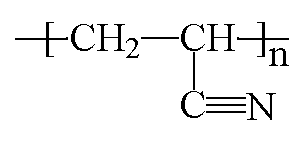
پلی آکریلو نیتریل ( Polyacrylonitrile ) ( PAN )

Polyacrylonitrile


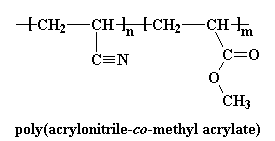
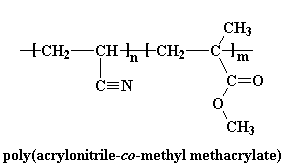
Polyacrylonitrile is used for very few products an average consumer would be familiar with, except to make another polymer, carbon fiber. Homopolymers of polyacrylonitrile have been uses as fibers in hot gas filtration systems, outdoor awnings, sails for yachts, and even fiber reinforced concrete. But mostly copolymers containing polyacrylonitrile are used as fibers to make knitted clothing, like socks and sweaters, as well as outdoor products like tents and such. If the label of some piece of clothing says "acrylic", then it's made out of some copolymer of polyacrylonitrile. Usually they're copolymers of acrylonitrile and methyl acrylate, or acrylonitrile and methyl methacrylate:

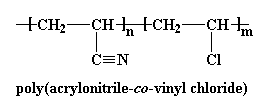
Also, sometimes we make copolymers of acrylonitrile and vinyl chloride. These copolymers are flame-retardant, and the fibers made from them are called modacrylic fibers.

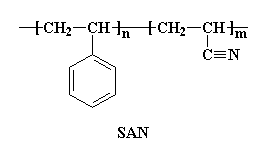
But the slew of copolymers of acrylonitrile doesn't stop there. Poly(styrene-co-acrylonitrile) (SAN) and poly(acrylonitrile-co-butadiene-co--styrene) (ABS), are used as plastics.

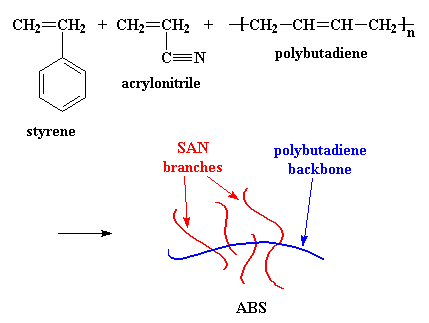
SAN is a simple random copolymer of styrene and acrylonitrile. But ABS is more complicated. It's made by polymerizing styrene and acrylonitrile in the presence of polybutadiene. Polybutadiene has carbon-carbon double bonds in it, which can polymerize, too. So we end up with a polybutadiene chain with SAN chains grafted onto it, like you see below.

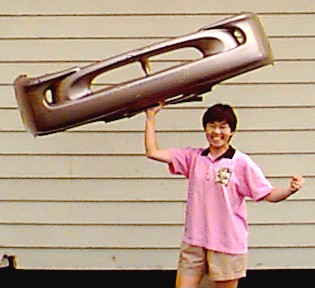
ABS is very strong and lightweight. It is strong enough to be used to make automobile body parts, but it is so light that Wassana can lift this front bumper fascia over her head with only hand! Using plastics like ABS makes automobiles lighter, so they use less fuel, and therefore they pollute less.

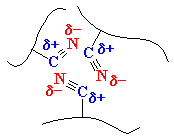
ABS is a stronger plastic than polystyrene because of the nitrile groups of its acrylonitrile units. The nitrile groups are very polar, so they are attracted to each other. This allows opposite charges on the nitrile groups to stabilize each other like you see in the picture on the left. This strong attraction holds ABS chains together tightly, making the material stronger. Also the rubbery polybutadiene makes ABS tougher than polystyrene.

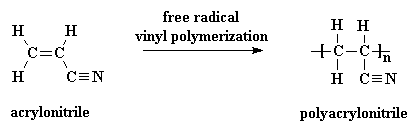
Polyacrylonitrile is a vinyl polymer, and a derivative of the acrylate family of polymers. It is made from the monomer acrylonitrile by free radical vinyl polymerization.


reference of this text is : http://pslc.ws/

Ammar Ghasemian Azizi ; e-mail: ammar5ghasemian@yahoo.com or azizi@fmplastics.nl ; Tel : +98 912 386 2365


پلی آکریلو نیتریل

+ نوشته شده در  شنبه بیست و هشتم دی ۱۳۸۷ساعت 16:34  توسط Polymer Eng. Corp  | 

پلی دی متیل سیلوکسان ( Poly dimethyl siloxane ) ( PDMS )

POLYDIMETHYLSILOXANE

Prepared at the 37th JECFA (1990), published in FNP 52 (1992) superseding specifications prepared at the 29th JECFA (1985), published in FNP 34 (1986). Metals and arsenic specifications revised at the 61st JECFA (2003). An ADI of 0-1.5 mg/kg bw was established at the 23rd JECFA (1979)

SYNONYMS

Poly(dimethylsiloxane), dimethylpolysiloxane, dimethylsilicone fluid, dimethylsilicone oil; INS No. 900

DEFINITION

Consists of fully methylated linear siloxane polymers containing repeating units of the formula (CH3)2SiO, with trimethylsiloxy end-blocking units of the formula (CH3)3SiO-

The article of commerce used as an antifoaming agent can be further specified as to total silicon

Chemical names

Simethicone (CAS name)

C.A.S. number

8050-81-5

Formula weight

6,800 to 30,000 (average and approximate)

Assay

Silicon content not less than 37.3% and not more than 38.5% of the total

DESCRIPTION

Clear, colourless, viscous liquid. Polydimethylsiloxane is frequently used in commerce as such, as a liquid containing 4-5% silica gel, and as an aqueous emulsion formulation containing, in addition to silica gel, emulsifiers and preservatives. The pure substance described here can be isolated by centrifuging from the silica gel-containing liquid at about 20,000 rpm.

FUNCTIONAL USES

Antifoaming agent, anticaking agent

CHARACTERISTICS

IDENTIFICATION

Solubility (Vol. 4)

Insoluble in water and in ethanol; soluble in carbon tetrachloride, benzene, chloroform, diethyl ether, toluene and other organic solvents

Specific gravity (Vol. 4)

d (25, 25): 0.964 - 0.977

Refractive index (Vol. 4)

n (25, D): 1.400 - 1.405

Infrared absorption

The infrared spectrum of the sample corresponds with the reference infrared spectrum below. Prepare two solutions containing: (1) 10% of sample in carbon tetrachloride and (2) 2% of sample in carbon disulfide. Obtain the infrared spectrum for the sample using the carbon disulfide solution (2) from 1300 to 650 cm-1. The solvent in the reference cell is also changed at the appropriate wave numbers to correspond to the sample solution.

PURITY

Loss on drying (Vol. 4)

Not more than 0.5% (150o, 4 h)

Viscosity

100 - 1500 cSt at 25o

See description under TESTS

Lead (Vol. 4)

Not more than 1 mg/kg

Determine using an atomic absorption technique appropriate to the specified level. The selection of sample size and method of sample preparation may be based on the principles of the method described in Volume 4, "Instrumental Methods."

TESTS

PURITY TESTS

Viscosity

Apparatus:

The Ubbelohde suspended level viscometer, shown in the accompanying diagram, is preferred for the determination of the viscosity.


Identification
Name Poly(dimethylsiloxane)
Synonyms Dimethylpolysiloxane; Dimethicone; Simethicone
copyRight
Molecular Structure Poly(dimethylsiloxane), Dimethylpolysiloxane, Dimethicone, Simethicone, CAS #: 9016-00-6
Molecular Formula (C2H6OSi)n
CAS Registry Number 9016-00-6
 
Properties
Density 0.971
Water solubility INSOLUBLE
 
Safety Data
Safety Description S24/25    Details
 
List of Suppliers
The Complete List of Suppliers for Poly(dimethylsiloxane)

references of this text are : http://www.fao.org/ and http://www.chemblink.com/

for more information you can see : http://en.wikipedia.org/wiki/Polydimethylsiloxane
 
 
مطلبی راجع به پلی دی متیل سیلوکسان به زبان فارسی در لینک زیر بخوانید و در صورت تمایل آنرا تکمیل کنید و ویکیپدیا را یاری کنید:

Ammar Ghasemian Azizi ; e-mail: ammar5ghasemian@yahoo.com and ammar_ghasemianazizi@as-tpe.com ; Tel: +98 912 386 2365 ; پلی دی متیل سیلوکسان

+ نوشته شده در  چهارشنبه بیست و پنجم دی ۱۳۸۷ساعت 23:33  توسط Polymer Eng. Corp  | 

دانلود رایگان کتاب هندبوک آلیاژ های پلیمری ( free download of polymer blends handbook )

سلام دوستان عزیز و گرامی

پس از مدت ها که به دنبال دانلود رایگان کتاب " Polymer Blends Handbook " نوشته " L. A. Utracki "

بودم بالاخره جلد اول این کتاب دو جلدی رو پیدا کردم . لینک رو در اختیار شما قرار میدم تا دوستان عزیزی که به دنبال این کتاب هستند نیز بتونند از این کتاب استفاده کنند .

Polymer Blends Handbook , By Leszek A. Utracki

  • Publisher: Springer
  • Number Of Pages: 1442
  • Publication Date: 2002-12-01
  • ISBN-10 / ASIN: 1402011105
  • ISBN-13 / EAN: 9781402011108

you can have free download of " Polymer Blends Handbook, By Leszek A. Utracki
" in the below link :

http://rs3.rapidshare.com/files/12618568/PBH.rar

after clicking the link please click on " free user " button and then click on " download " button .

 بعد از کلیک کردن بر روی لینک فوق صفحه ای جدید باز میشه که در اون دکمه " free user " رو کلیک کنید و صبر کنید تا ثانیه ها سپری بشه و یک گوی آبی رنگ که روی اون نوشته " download " ظاهر بشه سپس روش کلیک کنید تا دانلود انجام بشه .


Ammar Ghasemian Azizi ; e-mail: ammar_ghasemianazizi@as-tpe.com or

ammar5ghasemian@yahoo.com


+ نوشته شده در  جمعه بیستم دی ۱۳۸۷ساعت 20:57  توسط Polymer Eng. Corp  | 

پلی یورتان ها


Polyurethanes


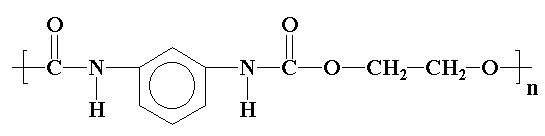
Polyurethanes are the most well known polymers used to make foams. If you're sitting on a padded chair right now, the cushion is more than likely made of a polyurethane foam. Polyurethanes are more than foam.

Much more than foam!

Polyurethanes are the single most versatile family of polymers there is. Polyurethanes can be elastomers, and they can be paints. They can be fibers, and they can be adhesives. They just pop up everywhere. A wonderfully bizarre polyurethane is spandex.

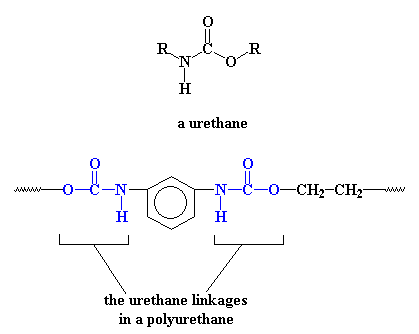
Of course, polyurethanes are called polyurethanes because in their backbones they have a urethane linkage.

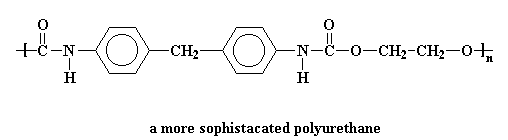
The picture shows the a simple polyurethane, but a polyurethane can be any polymer containing the urethane linkage in its backbone chain. More sophisticated polyurethanes are possible, for example:

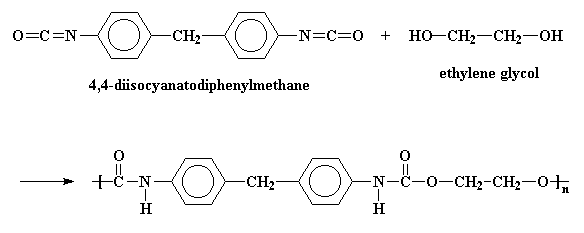
Polyurethanes are made by reacting diisocyanates with di-alcohols. To find out how, click here.

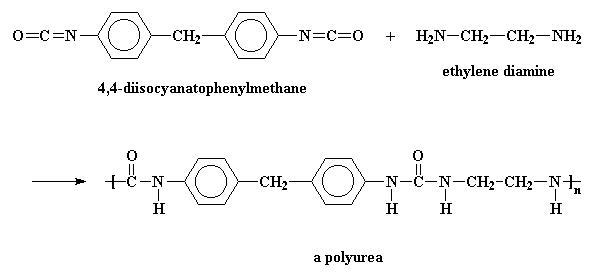
Sometimes, the dialcohol is replaced with a diamine, and the polymer we get is a polyurea, because it contains a urea linkage, rather than a urethane linkage. But these are usually called polyurethanes, because they probably wouldn't sell well with a name like polyurea.

Polyurethanes can hydrogen bond very well, and thus can be very crystalline. For this reason they are often used to make block copolymers with soft rubbery polymers. These block copolymers have properties of thermoplastic elastomers.

Spandex

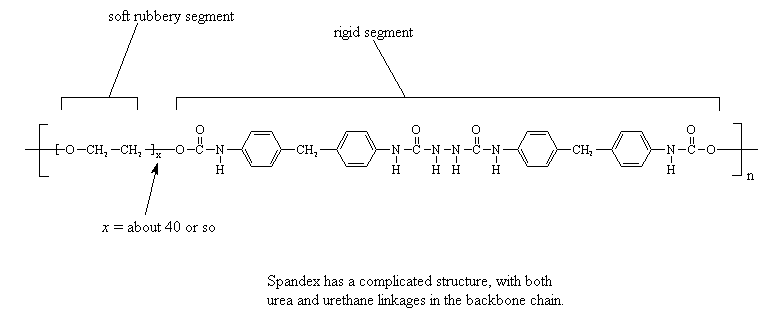
One unusual polyurethane thermoplastic elastomer is spandex, which DuPont sells under the trade name Lycra. It has both urea and urethane linkages in its backbone. What gives spandex its special properties is the fact that it has hard and soft blocks in its repeat structure. The short polymeric chain of a polyglycol, usually about forty or so repeats units long, is soft and rubbery. The rest of the repeat unit, you know, the stretch with the urethane linkages, the urea linkages, and the aromatic groups, is extremely rigid. This section is stiff enough that the rigid sections from different chains clump together and align to form fibers. Of course, they are unusual fibers, as the fibrous domains formed by the stiff blocks are linked together by the rubbery soft sections. The result is a fiber that acts like an elastomer! This allows us to make fabric that stretches for exercise clothing and the like.


this page sponsored by BAYER MATERIAL SCIENCE for http://pslc.ws/


Ammar Ghasemian Azizi ;

the reference of this text is : http://pslc.ws/

e-mail : azizi@fmplastics.nl or ammar5ghasemian@yahoo.com

Tel : +98 912 386 2365


+ نوشته شده در  دوشنبه شانزدهم دی ۱۳۸۷ساعت 23:25  توسط Polymer Eng. Corp  | 

پلی کربنات

Polycarbonates


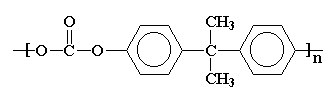
Polycarbonate, or specifically polycarbonate of bisphenol A, is a clear plastic used to make shatterproof windows, lightweight eyeglass lenses, and such. General Electric makes this stuff and sells it as Lexan.


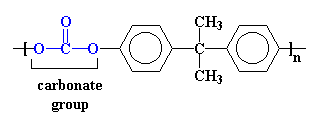
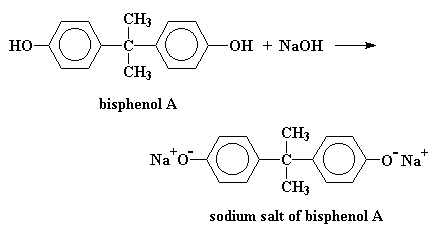
Polycarbonate gets its name from the carbonate groups in its backbone chain. We call it polycarbonate of bisphenol A because it is made from bisphenol A and phosgene. This starts out with the reaction of bisphenol A with sodium hydroxide to get the sodium salt of bisphenol A.


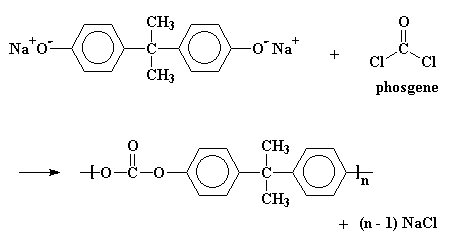
The sodium salt of bisphenol A is then reacted with phosgene, a right nasty compound which was a favorite chemical weapon in World War I, to produce the polycarbonate.


What? You want the gritty details of the reaction? Then click here and you will not be disappointed.

Another polymer used for unbreakable windows is poly(methyl methacrylate).

Seeing Another Polycarbonate More Clearly

Up until now, we've been talking about only one polycarbonate, polycarbonate of bisphenol A. But there's another polycarbonate out there, that some of us look at all the time. In fact, some of us, like me, never look at anything without the help of this polycarbonate. This is the polycarbonate that is used to make ultra-light eyeglass lenses. For people with really bad eyesight, like me, if the lenses were made out of glass, they would be so thick that they'd be too heavy to wear. I know. I used to have glass lenses. My glasses were so heavy that wearing them gave me a headache. But this new polycarbonate changed all that. Not only is it a lot lighter than glass, but it has a much higher refractive index. That means it bends light more than glass, so my glasses don't need to be nearly so thick.

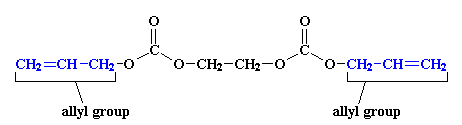
So what is this wonderful new polycarbonate? It's very different from polycarbonate of bisphenol A. We make it by starting with this monomer:

You can see that it has two allyl groups on the ends. These allyl groups have carbon-carbon double bonds in them. This means they can polymerize by free radical vinyl polymerization. Of course, there are two allyl groups on each monomer. The two allyl groups will become parts of different polymer chains. In this way, all the chains will become tied together to form a crosslinked material that looks like this:

As you can see, the carbonate-containing groups (shown in blue) for the crosslinks between the polymer chains (shown in red). This crosslinking is makes the material very strong, so it won't break nearly as easily as glass will. This is really important for kids' glasses! If only this stuff had been invented when I was a kid!

There is a fundamental difference in the two types of polycarbonate described here that I should point out. Polycarbonate of bisphenol A is a thermoplastic. This means it can be molded when it is hot. But the polycarbonate used in eyeglasses is a thermoset. Thermosets do not melt, and they can't be remolded. They are used to make things that need to be really strong and heat resistant.


Ammar Ghasemian Azizi ; the reference of this text is : http://pslc.ws/

e-mail : azizi@fmplastics.nl or ammar5ghasemian@yahoo.com

Tel : +98 912 386 2365

+ نوشته شده در  دوشنبه شانزدهم دی ۱۳۸۷ساعت 23:10  توسط Polymer Eng. Corp  | 

پلی دی سایکلو پنتا داین ( پلی دی سیکلو پنتا دی ان ) Polydicyclopentadiene

Polydicyclopentadiene


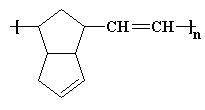
Polydicyclopentadiene is a polymer used to make really, really big things in one piece. And by big, I mean BIG. With polydicyclopentadiene you can make a whole tractor cab in one piece, or a whole satellite dish antenna. That's not good enough for you? Then how about a 1500 gallon storage tank for dangerous chemicals? With polydicyclopentadiene that's no problem. But the very first use for it was the cowlings of snowmobiles, again molded in one piece. This was because it has very good impact resistance at low temperatures, where a lot of other polymers become brittle.

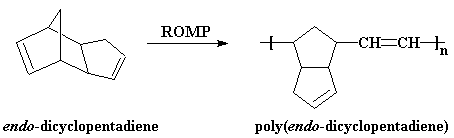
Polydicyclopentadiene is made by a nifty reaction called ring-opening metathesis polymerization (ROMP) from the monomer endo-dicyclopentadiene. Click here if you want to see the monomer in 3-D.

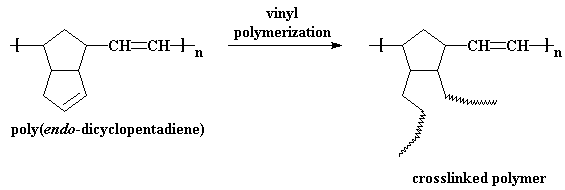
But it's not done yet! There's a double bond left in the bottom ring, as you can see in the picture of polydicyclopentadiene. These can undergo vinyl polymerization, to give us a crosslinked thermoset material.

This thermoset is good stuff, but you can't mold a thermoset. So how do we make anything from it? The answer is to make it in chunks that are already shaped like we want them. The fancy name for this is called reaction injection molding or RIM for short. Put simply, we fill a mold full of the monomer, and polymerize it in the mold. That's how we can make products from thermosets.


Ammar Ghasemian Azizi ; the reference of this text is : http://pslc.ws/

e-mail : azizi@fmplastics.nl or ammar5ghasemian@yahoo.com

Tel : +98 912 386 2365


+ نوشته شده در  دوشنبه شانزدهم دی ۱۳۸۷ساعت 23:7  توسط Polymer Eng. Corp  | 

پلی ایماید ها

Polyimides


Polyimides are a very interesting group of incredibly strong and astoundingly heat and chemical resistant polymers. Their strength and heat and chemical resistance are so great that these materials often replace glass and metals, such as steel, in many demanding industrial applications. Polyimides are even used in many everyday applications. Who knows, you may even have a few in your house. They are used for the struts and chassis in some cars as well as some parts under-the-hood because they can withstand the intense heat and corrosive lubricants, fuels, and coolants cars require. Do you have polyimides in your kitchen? They are also used in the construction of many appliances as well as microwave cookware and food packaging because of their thermal stability, resistance to oils, greases, and fats (YUM!), and their transparency to microwave radiation. They can also be used in circuit boards, insulation, fibers for protective clothing, composites, and adhesives.

By now you have probably guessed that a polyimide is a polymer that contains an imide group.

Yeah, I figured that out, but what is an imide?

I just knew you were going to ask that. An imide is a group in a molecule that has a general structure (drawn in red) which looks like this:
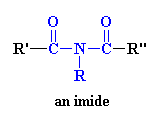
So if the molecule shown above were to be polymerized the product would be, you guessed it, a polyimide. Polyimides usually take one of two forms. The first of these is a linear structure where the atoms of the imide group are part of a linear chain. The second of these structures is a heterocyclic structure where the imide group is part of a cyclic unit in the polymer chain. Take a look.
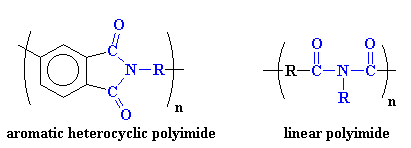
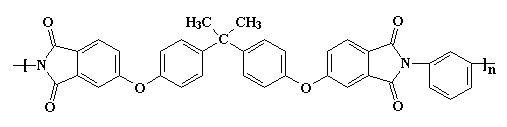
Aromatic heterocyclic polyimides, like the one on the left, are typical of most commercial polyimides, such as Ultem from G.E. and DuPont's Kapton, and are therefore the polyimides we will be spending most of our time on. These polymers have such incredible mechanical and thermal properties that they are used in place of metals and glass in many high performance applications in the electronics, automotive, and even the aerospace industries. These properties come from strong intermolecular forces between the polymer chains.

A polymer which contains a charge transfer complex consists of two different types of monomers, a donor and an acceptor. The donor is like a rich man with more money than he knows what to do with. It has plenty of electrons to go around because of its nitrogen groups. The acceptor, then, is like a mooching houseguest. Its carbonyl groups, like our houseguest's many vices of gambling, drinking and such, sucks away its electron density. The donor doesn't mind supporting the acceptor, in fact, with the acceptor around, the donor looks better. Charity looks good in some social circles (and it's good for a tax break too!). So the donor lends some of its electrons to the acceptor, holding them tightly together.
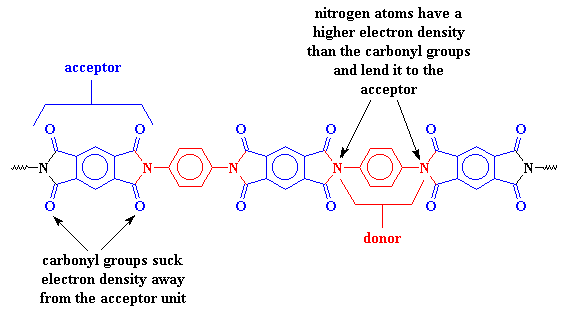
 

The charge transfer complex works not only between adjacent units in the polymer chain, but also between chains. The chains will stack together like strips of paper, with donors and acceptors paired up.
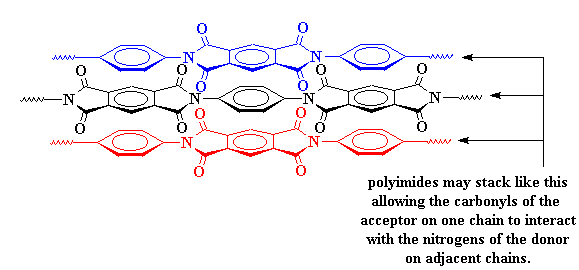
This charge transfer complex holds the chains together very tightly, not allowing them to move around very much. When things can't move around on the molecular level, they can't move around in the whole material. This is why polyimides are so strong.

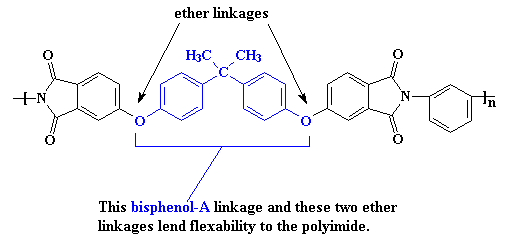
The charge transfer complex is so strong, it sometimes becomes necessary to make the polymer a little softer so it is able to be processed. This is accomplished with the bisphenol-A derived linkage shown in the polymer segment below.
Another interesting property of polyimides which makes them excellent for use in construction and transportation industries is they burn.

Why would you want to build a building or a car out of something that burns?

Good question, and I can answer it too. It is not the burning which industry likes, but polyimide's self extinguishing property which builders like. Self extinguishing? Yes, when an aromatic polyimide catches on fire, which by the way is difficult to begin with, a surface char develops which smothers the flame, blocking it from the fuel to burn. Then you just wipe it off, and it's just like the fire never happened. Neat, huh?


reference of this text is : http://pslc.ws/ ( by Gregory Brust )

Ammar Ghasemian Azizi ; e-mail : azizi@fmplastics.nl or ammar5ghasemian@yahoo.com ; Tel : +98 912 386 2365 ;


+ نوشته شده در  دوشنبه شانزدهم دی ۱۳۸۷ساعت 22:59  توسط Polymer Eng. Corp  | 

انواع ترموپلاستیک الاستومر های کوپلیمری


سلام دوستان عزیز و گرامی :

 انواع ترموپلاستیک الاستومر های کوپلیمری به شرح زیر هستش . اگر سوالی در این رابطه و یا ترموپلاستیک الاستومر های آلیاژی داشتید حتما بپرسید با کمال میل جواب خواهم داد .

TPE-U ( ترموپلاستیک الاستومر های یورتانی )

TPE-A ( ترموپلاستیک الاستومر های آمیدی )

TPE-S ( ترموپلاستیک الاستومر های استایرنی )

TPE-E (ترموپلاستیک الاستومر های استری  )

TPE-Silicone ( ترموپلاستیک الاستومر های سیلیکونی )


+ نوشته شده در  سه شنبه دهم دی ۱۳۸۷ساعت 23:40  توسط Polymer Eng. Corp  | 

انیمیشن چند واکنش پلیمریزاسیون

سلام دوستان گرامی

لینک اول مربوط به انیمیشن واکنش Polycondensation یک پلی استر هستش ( مربوط به PET ) :

http://www.uwsp.edu/chemistry/tzamis/condensationpolymer.html  ( This is an animation of a polyester condensation polymerization. )

لینک دوم هم مربوط به واکنش پلیمریزاسیون رادیکال آزاد با شروع پراکسیدی مربوط به پلی اتیلن هستش :

http://www.uwsp.edu/chemistry/tzamis/additionpolymer.html ( This is an animation of a peroxide initiated free radical polymerization. )

یک انیمیشن راجع به دی.ان.ای ( DNA ) که چون خارج از تخصص بنده هستش توضیح اضافه نمیدم :

http://www.biostudio.com/d_%20DNA%20Replication%20Nucleotide%20Polymerization.htm ( DNA animation )

یک انیمیشن کلی راجع به Condensation Polymerization :

http://www.yenka.com/freecontent/attachment.action?quick=121&att=2727 ( Condensation Polymerization Animation )

انیمیشنی راجع به تشکیل سلولز :

http://www.yenka.com/freecontent/attachment.action?quick=11z&att=2723 ( Forming cellulose Animation )

انیمیشنی راجع به تشکیل نشاسته :

http://www.yenka.com/freecontent/attachment.action?quick=11y&att=2721 ( Forming starch Animation )

انیمیشنی راجع به هیدرولیز نشاسته ( که خارج از تخصص بنده است ، لطفا در این مورد سوال نفرمائید ) :

http://www.yenka.com/freecontent/attachment.action?quick=120&att=2725 ( Hydrolysing starch Animation )

انیمیشنی راجع به واکنش استریفیکاسیون ( Esterification ) :

http://www.yenka.com/freecontent/attachment.action?quick=11v&att=2715 ( Esterification Animation )

انیمیشنی راجع به پلیمریزاسیون رادیکالی با شروع نوری :

http://www.ehb.itu.edu.tr/~yusuf/flash/linear.swf  ( Photo initiation radical polymerization Animation )

انیمیشنی راجع به فرآیند کراسلینکینگ در مونومر های دو عاملی :

http://www.ehb.itu.edu.tr/~yusuf/flash/crosslinking.swf ( Cross-linking in bifunctional monomers Animation )


عمار قاسمیان عزیزی ؛ : Ammar Ghasemian Azizi ;

 E-mail : ammar5ghasemian@yahoo.com or ammar_ghasemianazizi@as-tpe.com

Tel : +98 912 386 2365


+ نوشته شده در  پنجشنبه پنجم دی ۱۳۸۷ساعت 17:22  توسط Polymer Eng. Corp  | 

پلیمر های ذاتا هادی ( در پست های بعدی نیز مطالب ارزشمندی در این رابطه درج شده است - ویرایش 1391 )

A large number of application areas using inherently conductive polymers have been developed and tested. Each is based on properties that are specific to these materials. Due to the recent development of several air-stable highly conductive polymers, and the fast entry of these products into the marketplace, several applications have already been possible, and numerous others are going to be easily realized.

The unique properties of inherently conductive polymers stem from (i) the possibility of fine-tuning the conductivity by adjusting the amount of dopant incorporated within the polymer, (ii) doping/undoping reversibility, and (iii) the optical absorption characteristics in the UV, visible and near infrared as well as its electromagnetic absorption characteristics.

Several polymers have been tested and proved to work in a variety of applications including batteries, capacitors, smart windows, light emitting diodes, transistors, photovoltaics, microlithography, corrosion control, conductive adhesives and inks, static dissipation, EMI shielding, radar/microwave absorption, direct plating, electrostatic powder coating, clean room applications, sensors, and drug delivery systems.The status of commercial products and devices will be given during the seminar.Examples of some polymers are shown below:


Reference of this text is : http://www.conductivepolymers.com/


Ammar Ghasemian Azizi ; ammar5ghasemian@yahoo.com or

azizi@fmplastics.nl

Tel : +98 912 386 2365


+ نوشته شده در  سه شنبه سوم دی ۱۳۸۷ساعت 1:59  توسط Polymer Eng. Corp  | 

پلی اتر سولفون  ( PES )

Poly(ether sulfones)

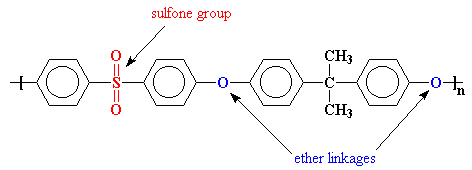
Poly(ether sulfones) PES for short, are high performance polymers. The most popular is one made by Union Carbide called UdelTM. That's the one you see in the picture at the top of the page. Poly(ether sulfones) act a lot like polycarbonates, but they're a lot more heat resistant.

Poly(ether sulfones) also can stand up well to water and steam, so they're used to make things like cookware and medical products that need to be sterilized between uses.

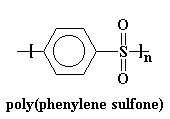
Poly(ether sulfones get their name because they have ether groups and sulfone groups in their backbone chains. PES polymers have high glass transition temperatures, or Tg's, because the sulfone groups are so stiff. In fact, poly(phenyl sulfone) is so stiff that it doesn't have a glass transition temperature! It stays hard as a rock right up until it decomposes at around 500 oC.

This is bad. This means that it can't be processed. In order to make it processable, we have to make that chain a little more flexible so the polymer will soften at a reasonable temperature. We do this by putting flexible groups in the backbone chain, namely ether linkages.

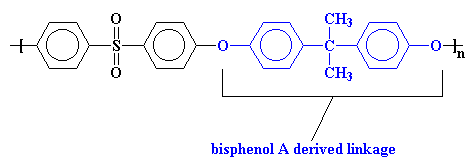
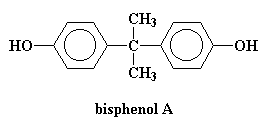
UdelTM uses a bisphenol A derived linkage to make the chain flexible. You'll notice that this polymer has two ether linkages in the repeat unit. For this reason UdelTM is more properly called a poly(ether ether sulfone).

We call this a bisphenol A linkage because it's based on the monomer bisphenol A, but more about that later.

This brings the Tg down to 190oC. By playing around and using different kinds of flexible groups we can alter the Tg further. If we use a less flexible linkage, the Tg jumps to 230 oC.

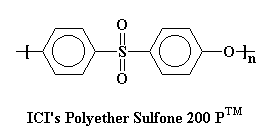
This PES is made by Imperial Chemical Industries (ICI), and they call it by the romantic name of Polyether Sulfone 200 PTM. You'll notice that unlike UdelTM, this polymer has only one ether linkage between sulfone groups. This makes the chain stiffer and the Tg higher.

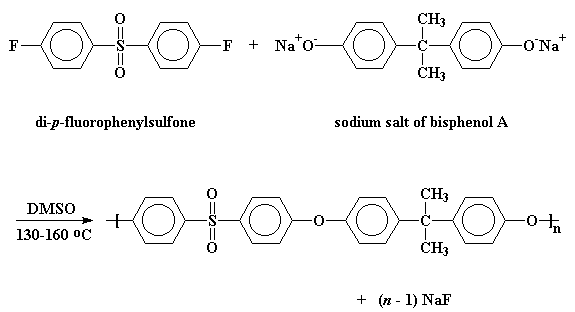
But you ask, "How do we make a wonderful poly(ether sulfone)?" Like this: One reacts the sodium salt of bisphenol A (remember bisphenol A?) and reacts it with di-para-fluorophenylsulfone in a solvent like dimethylsulfoxide (DMSO) at between 130 and 160 oC.

And that gets us a poly(ether sulfone)!


Referece of tihs text is : http://pslc.ws/

for more info. you can see this site :

 http://www.tangram.co.uk/TI-Polymer-PES.html ( good info. about PES )


Ammar Ghasemian Azizi ; ammar5ghasemian@yahoo.com or azizi@fmplastics.nl

Tel : +98 912 386 2365


+ نوشته شده در  سه شنبه سوم دی ۱۳۸۷ساعت 1:42  توسط Polymer Eng. Corp  | 

پلی اتر اتر کتون ( PEEK ) ( در پست های بعدی نیز مطالب ارزشمندی در این رابطه آمده است - ویرایش 1391 )


Peek Molecule
This linear aromatic polymer is semi-crystalline and is widely regarded as the highest performance thermoplastic material currently available. A summary of key physical properties is as follows: 

High Temperature Performance
PEEK polymer and compounds typically have a glass transition temperature of 289°F (143°C) and a melting temperature of 649°F (343°C). Independent tests have shown that PEEK polymer exhibits a heat distortion temperature up to 599°F (315°C) (ISO R75, glass fiber filled) and a Continuous Use Temperature of 500°F (260°C) (UL 746B).

Wear Resistance
PEEK polymer has excellent friction and wear properties which are optimized in the specially formulated tribological grades 450FC30 and 150FC30. These materials exhibit outstanding wear resistance over wide ranges of pressure, velocity, temperature and counterfacial roughness.

Chemical Resistance
PEEK polymer has excellent resistance to a wide range of chemical environments, even at elevated temperatures. The only common environment which dissolves PEEK polymer is concentrated sulphuric acid.

Fire, Smoke and Toxicity
PEEK polymer is highly stable and requires no flame retardant additives to achieve a V-0 rating at 0.057 inch thickness. The composition and inherent purity of the material results in extremely low smoke and toxic gas emission in fire situations.

Hydrolysis Resistance
PEEK polymer and compounds are not chemically attacked by water or pressurized steam. Components which are constructed from these materials retain a high level of mechanical properties when continuously conditioned in water at elevated temperatures and pressures.

Electrical Properties
The electrical properties of PEEK polymer are maintained over a wide frequency and temperature range.

Purity
PEEK polymer materials are inherently pure with exceptionally low levels of ionic extractables and excellent outgassing characteristics


Reference of this text is : http://www.zeusinc.com/index_wo.asp

Ammar Ghasemian Azizi ; ammar5ghasemian@yahoo.com or azizi@fmplastics.nl

Tel : +98 912 386 2365


+ نوشته شده در  سه شنبه سوم دی ۱۳۸۷ساعت 1:18  توسط Polymer Eng. Corp  |