Polymer Industry

دنور در واحد پلی پروپیلن چیست؟ what is Donor in PP plant (polypropylene plant) ?

Donor: Dicyclopentyldimethoxysilane


Dicyclopentyldimethoxysilane

CAS No.131390-32-4
Chemical Name:Dicyclopentyldimethoxysilane
Synonyms:Dicyclopentyldimethoxysilan;Dicyclopentyldimethoxysilane;DICYCLOPHENTYLDIMETHOXYSILANE;Silane, dicyclopentyldimethoxy-
CBNumber:CB8255998
Molecular Formula:C12H24O2Si
Formula Weight:228.4
MOL File:131390-32-4.mol
Dicyclopentyldimethoxysilane Property
mp : <0°C
bp : 251°C
density : 1.00
refractive index : 1.4663
Fp : 102°C
CAS DataBase Reference: 131390-32-4(CAS DataBase Reference)
Safety
Hazard Codes : Xi,N
Risk Statements : 38-51/53-50/53-41
Safety Statements : 24/25-36/37/39-61-60-37/39-26
RIDADR : 3082
TSCA : Yes


1. A process to make polypropylene or propylene copolymer comprising:

a. polymerizing propylene in a reactor system having two or more different flow regimes wherein at least one of the flow regimes has a volumetric solid holdup larger than 15%;

b. adding a catalyst system comprising a mixed external electron donor system to the reactor, wherein the mixed external electron donor system comprises at least one selectivity control agent and at least one activity limiting agent; wherein the catalyst system further comprises an aluminum containing cocatalyst and wherein the aluminum to mixed external electron donor mole ratio is in the range of from 0.5 to 4.0:1.

2. The process of claim 1 wherein the activity limiting agent is a carboxylic acid ester, a diether, a poly(alkene glycol), a diol ester, or a combination thereof.

3. The process of claim 1 wherein the activity limiting agent is selected from a benzoate, a C4-C30 aliphatic acid ester and combinations thereof.

4. The process of claim 1 wherein the activity limiting agent is selected from a laurate, a myristate, a palmitate, a stearate, an oleate or combinations thereof.

5. The process of claim 1 wherein the selectivity control agent is selected from the group consisting of an alkoxysilane, an amine, an ether, a carboxylate, a ketone, an amide, a carbamate, a phosphine, a phosphate, a phosphite, a sulfonate, a sulfone, a sulfoxide, and combinations thereof.

6. The process of claim 1 wherein the selectivity control agent corresponds to the formula SiRm(OR′)4-m, where R is C3-12 cycloalkyl, C3-12 branched alkyl, or C3-12 cyclic or acyclic amino group, R′ is C1-4 alkyl, and m is 0, 1, or 2.

7. The process of claim 6 wherein the selectivity control agent is selected from dicyclopentyldimethoxysilane, di-tert-butyldimethoxysilane, methylcyclohexyldimethoxysilane, methylcyclohexyldiethoxysilane, ethylcyclohexyldimethoxysilane, diphenyldimethoxysilane, diisopropyldimethoxysilane, di-n-propyldimethoxysilane, diisobutyldimethoxysilane, diisobutyldiethoxysilane, isobutylisopropyldimethoxysilane, di-n-butyldimethoxysilane, cyclopentyltrimethoxysilane, isopropyltrimethoxysilane, n-propyltrimethoxysilane, n-propyltriethoxysilane, ethyltriethoxysilane, tetramethoxysilane, tetraethoxysilane, diethylaminotriethoxysilane, cyclopentylpyrrolidinodimethoxysilane, bis(pyrrolidino)dimethoxysilane, bis(perhydroisoquinolino)dimethoxysilane, and dimethyldimethoxysilane.

8. The process of claim 1 wherein the mixed external electron donor system is selected from the group consisting of: dicyclopentyldimethoxysilane and isopropyl myristate; diisopropyldimethoxysilane and isopropyl myristate; dicyclopentyldimethoxysilane and poly(ethylene glycol) laurate; dicyclopentyldimethoxysilane, isopropyl myristate and poly(ethylene glycol) dioleate; methylcyclohexyldimethoxysilane and isopropyl myristate; n-propyltrimethoxysilane and isopropyl myristate; dimethyldimethoxysilane, methylcyclohexyldimethoxysilane and isopropyl myristate; dicyclopentyldimethoxysilane and n-propyltriethoxysilane and isopropyl myristate; diisopropyldimethoxysilane, n-propyltriethoxysilane and isopropyl myristate; dicyclopentyldimethoxysilane, tetraethoxysilane and isopropyl myristate; dicyclopentyldimethoxysilane, diisopropyldimethoxysilane, n-propyltriethoxysilane and isopropyl myristate; and combinations thereof.

9. The process of claim 1 wherein the mixed external electron donor comprises three or more different electron donors.

10. The process of claim 1 wherein the reactor system has two or more flow regimes selected from the group consisting of homogeneous fluidization, bubbling fluidization, turbulent fluidization, fast fluidization, spouted bed, spout-fluid bed, pneumatic convey (dense-phase and dilute phase), packed bed (fixed bed), packed (or fixed) moving bed and systems with multiple flow patterns within a single polymerization zone.

11. The process of claim 10 where the reactor system operates under two flow regimes; one is fast fluidization, and the other is packed moving bed.

12. The process of claim 1 wherein at least one of the flow regimes has the superficial gas velocity less than 23 times of the minimum fluidization velocity.

13. The process of claim 1, wherein the reactor system is making polypropylene homopolymer, ethylene-propylene copolymer, butene-propylene copolymer or an ethylene-butene-propylene terpolymer.

14. The process of claim 1, wherein at least a part of the reactor system is running under the condensing mode.

15. The process of claim 1 wherein the selectivity control agent and the activity limiting agent are added to the reactor separately.

16. The process of claim 1 wherein all external electron donors in the mixed external electron donor system are mixed together prior to adding to the reactor.

17. The process of claim 10 wherein at least one of the flow regimes has a fluidized bulk density greater than 8 lb/ft3.


برچسب‌ها: دنور چیست, Donor, واحد پلی پروپیلن, Polypropylene plant
+ نوشته شده در  چهارشنبه بیست و یکم فروردین ۱۳۹۲ساعت 21:44  توسط Polymer Eng. Corp  | 

پلی گلیکولاید (پلی گلیکولید ) - Polyglycolide - PGA


برچسب‌ها: پلی کلیکولید اسید, PGA, پلیمر زیست تخریب پذیر, ترپوپلاستیک زیست تخریب پذیر
+ نوشته شده در  چهارشنبه چهاردهم فروردین ۱۳۹۲ساعت 22:0  توسط Polymer Eng. Corp  | 

آلوتروپ های کربن - جون میده یک کار آزمایشگاهی کامپوزیتی با این آلوتروپ ها انجام بدی - Allotropes of


Allotropes of carbon

From Wikipedia, the free encyclopedia

Eight allotropes of carbon:  a) Diamond,   b) Graphite,  c) Lonsdaleite,  d) C60 (Buckminsterfullerene or buckyball),  e) C540,  f) C70,  g) Amorphous carbon, and  h) single-walled carbon nanotube or buckytube.


Eight allotropes of carbon: a) Diamond, b) Graphite, c) Lonsdaleite, d) C60 (Buckminsterfullerene or buckyball), e) C540, f) C70, g) Amorphous carbon, and h) single-walled carbon nanotube or buckytube.

This is a list of the allotropes of carbon.


برچسب‌ها: Eight allotropes of carbon, a, Diamond, b
+ نوشته شده در  چهارشنبه چهاردهم فروردین ۱۳۹۲ساعت 13:59  توسط Polymer Eng. Corp  | 

پلیمریزاسیون سولفور ( گوگرد ) - The polymerization of sulfor ( aka plastic sulfur )


Introduction

The polymerization of sulfur (aka plastic sulfur) has long been used as a demonstration in chemistry classes. I use it with freshman to try to link macroscopic observations with microscopic explanations. I use it again with physical chemistry students as an example of a substance with an interesting phase diagram and as an illustration of the conversion of substances into their most thermodynamically stable form in order to minimize chemical potentials. I have developed an animation of the demonstration with CACHE and GifBuilder to be used in conjunction with the demonstration in order to help students visualize the microscopic behavior that occurs during the heating of the sulfur.

The Demonstration

The supplies and equipment needed for the experiment are:

  • Powdered sulfur [Precipitated sulfur works well. Grinding solid sulfur in a mortar and pestle works best but charges during crushing (so is annoying at times). Avoid sublimated sulfur.]

  • Fisher burner with striker

  • Large test tube and appropriate holder

  • 500 mL beaker with 300-400 mL of water

  • Damp paper towel (to quench any sulfur flames and reduce SO2 production)
Put about 2 inches of sulfur in the test tube and heat slowly over the burner. Once melted, tip tube to show students the viscosity of the melted sulfur. Continue to heat. Typically, as liquids heat, the viscosity drops. Periodically stop and show the viscosity of the sulfur while continuing to heat. At some point, the viscosity changes markedly and the sulfur becomes like molasses. Show this viscosity. As the heating is reapplied, the viscosity will once again drop right before boiling. This change in viscosity is reversible and can be seen by letting the tube cool and the molasses reappear and disappear. Reheat the tube above the viscous state and then pour into the beaker of water. The sulfur will solidify in streams of rubbery material. Allow the students to observe (ie feel) the plastic sulfur. Keep a portion of the plastic sulfur for the next class. It will revert back to the yellow, rhombic form of sulfur (but not in crystalline form) and be hard again.

The Animations


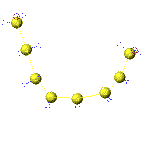
The first animation shows the shape of the elemental sulfur, S8 rings. It rotates to show students both the ring structure and the crown shape it resembles when viewed on its side.

Click on the graphic to see the first animation.


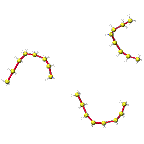
The second animation shows what happens to the ring as heat is applied to the melted sulfur. The increase in temperature is accompanied by an increase in motion and a bond within the ring become strained and finally broken. As the covalent bond breaks equally in half, a diradical is formed.

Click on the graphic to see the second animation.


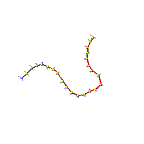
The third animation shows the coming together of two radicals to form a long chain. This is the polymerization process. It is easier for the molecule to find radicals on other molecules than to find the radical on the other end of its own chain. Polymerization occurs to form long chains.

Click on the graphic to see the third animation.


The fourth animation shows the presence of many polymeric chains and the effect on the motion of the sulfur chain. This illustrates the increase in viscosity observed when the polymers are formed. The last frame shows the presence of many chains in the sample.


The fifth animation zooms in on a region of the tangled mess and illustrates what happens when the polymer continues to be heated. The rise in kinetic energy once again causes bonds to be stretched, weakened and broken, resulting in a liquid that contains small fragments of sulfur chains. The viscosity is easily shown to be lower at this point than with the polymeric sulfur by the ease of its motion. When sulfur boils, it has been observed to contain not only S8 but smaller fragments such as S4 as well.

Reference of this text is: THIS LINK

or this direct website address: http://www.thecatalyst.org/experiments/Dunlavy/Dunlavy.html

Deanna Dunlavy
June 25, 1998

+ نوشته شده در  دوشنبه دوازدهم فروردین ۱۳۹۲ساعت 23:43  توسط Polymer Eng. Corp  | 

Additives can be classified according to several criteria, i.e:

Additives can be classified according to several criteria, i.e:

1- Field of application,

2- Chemical structure,

3- Molecular weight,

4- Mode of action,

5- Polymer type to be used,

6- Reactivenes,

7- Effectiveness,

8- Side effects (multipurpose actions),

9- Commercial Importance,

Reference of this text is: THIS LINK (this reference is a good online book about polymer's additives)


+ نوشته شده در  پنجشنبه هشتم فروردین ۱۳۹۲ساعت 21:44  توسط Polymer Eng. Corp  | 

رفرنس: خبر آنلاین (این مطلب مربوط به سال 89 بوده و قیمت های ذکر شده اکنون بالاتر می باشند)


کتابخانه شما چقدر می​ارزد؟ / کتاب​های میلیونی در بازار

ادبیات - فقط قیمت کتاب​های خطی میلیونی نیست، در بین کتاب​های دست دوم هم کتاب​هایی پیدا می‌شوند که قیمت​شان نجومی است.

به گزارش خبرآنلاین، کتاب​ها هم می​​توانند قیمت​های میلیونی داشته باشند، مخصوصا اگر چند دهه از تاریخ چاپشان گذشته باشد و تجدید چاپ هم نشده باشند.مثل شاهنامه​ای که انتشارات امیر کبیر چند دهه پیش روانه بازار کرد و حالا قیمتش چیزی حدود یک میلیون و 500 تا 2 میلیون تومان است.

قیمت کتاب​های نایاب اگرچه همیشه چشمگیر بوده، اما چند سالی هست که قیمت​ها سیر صعودی جالبی پیدا کرده​اند.

قانون عرضه و تقاضا در بازار کتاب​های دست دوم هم حاکم است. وقتی تقاضا زیاد باشد و عرضه کم، خود به خود قیمت​ها سر به فلک می​زنند.مثل اتفاقی که حالا برای خیلی از کتاب​ها افتاده است. تیراژ این کتاب​ها ثابت است، خیلی از آدم​هایی هم که در دهه 30 و 40 این کتاب​ها را می خریدند و اصطلاحا کتابخانه شخصی داشتند، حالا عمرشان را داده​اند به شما و کتابخانه هایشان هم به فروش رفته . به همین خاطر این روز ها کتابخانه های شخصی زیادی برای خریدن پیدا نمی شود تا کتابفروش ها آن​ها را بخرند و توی قفسه​های کتابفروشی​هایشان بچینند.

چاپ کتاب در زیر زمیناصطلاح زیر زمینی تنها مختص حوزه موسیقی نیست،چند سال قبل از آن که واژه موسیقی زیر زمینی روی زبان​ها بیفتد،فعالیت زیر زمینی در حوزه کتاب شروع شده بود.زمانی که برخی​ها تصمیم گرفتند،کتاب​های نایاب را به صورت افستی و غیر قانونی چاپ و روانه بازار کنند.

این کتاب​ها طبیعتا چون غیر قانونی چاپ می​شدند ، راهی​ به کتابفروشی​ها نمی یافتند. به همین خاطر بساط فروش این کتاب​ها در حاشیه خیابان​ها و پیاده رو​ها پهن شد.

حالا در اکثر نقاط شهر می​شود بساطی​هایی را دید که دارند کتاب​های افست را می فروشند.کتاب​هایی که بدون اجازه ناشر و مولف چاپ می​شوند و خوب هم به فروش می​روند.

شاید زمانی که افست کردن کتاب​های نایاب باب شد، خیلی​ها فکر می​کرند بازار کتاب​های نایاب از رونق می​افتد،اما این اتفاق نیفتاد .دلیلش هم کاملا روشن است.کتاب افستی جای کتاب اصلی را برای کسانی که عشق کتاب دارند،نمی​گیرد.

رقابت در بازاربازار کتاب​های دست دوم قوانین خاص خودش را دارد.مثلا هر چقدر کتاب تمیز تر باشد،قیمتش بیشتر است.از طرف دیگر نوبت چاپ کتاب​ها هم مهم است.مثلا چاپ اول یک کتاب معمولا قیمتش از چاپ دهم یا یازدهم همان کتاب بیشتر است.

مثلا اگر کتاب کمدی الهی را می​خواهید بخرید، باید حتما حواستان باشد که صفحه​های بدرقه کتاب، مصور باشد،اگر این صفحه ها مصور نباشد، خود به خود از قیمت کتاب کم می​شود.

این ریزه کاری​ها در بین کتاب​های خیلی گران،گاهی باعث تفاوت قیمت 500 هزار تومانی می شود.مثلا شاهنامه چاپ انتشارات امیرکبیر یک تسمه دور جلد دارد،اگر این تسمه نباشد، کم کم 500 هزار تومان از قیمت کتاب کسر می شود.

با این حال اصلا فکر نکنید که می​توانید کتاب​هایی را که دارید با همین قیمت​ها بفروشید.شما برای فروش کتاب​های خودتان مجبورید به سراغ شماره​هایی بروید که معمولا زیر این جمله​ها نوشته شده اند:«کتابخانه شخصی شما را خریداریم.»

با این شماره​ها که تماس بگیرید تازه می​فهمید کسی حاضر نیست کتاب​های شما را با همان قیمتی بخردکه حالا در بازار کتاب​های دست دوم خرید و فروش می​شوند.

مدهای جدیددر بازار کتاب​های دست دوم هم هر از گاهی خرید و فروش برخی از کتاب​ها مد می​شود.حالا خرید و فروش کتاب​هابه صورت دوره​ای مد شده و قیمت دوره​ها نیز حسابی بالا رفته است.

از دوره کتاب​های جلد ببری انتشارات نیل گرفته تا دوره کتاب​های کلاسیک انتشارات امیرکبیر.کتاب​هایی که در بین آن​ها رمان هایی چون،«تهوع»سارتر،«صد سال تنهایی» مارکز،«انفجار در کلیسای جامع» آلخو کارپنتیه و«برباد رفته»مارگریت میچل هم دیده می شود.

تا چند سال پیش فقط برخی از این کتاب​ها مشتری داشتند،اما حالا کسی این کتاب​ها را تکی نمی​فروشد.کتابفروش​هایی که خودشان این مد​ها را راه می اندازند،خودشان هم حواسشان هست که چطوری می شود، قیمت یک کتاب را بالا برد و مد جدیدی در بازار کتاب های دست دوم راه انداخت.

البته فقط کتاب ها نیستند که در بازار دست دوم ها ارج و قرب دارند.مجله ها و روزنامه های قدیمی هم حسابی بازارشان در این حوزه رونق دارد.از دوره های مجله آدینه و دنیای سخن و سوره گرفته تا یکی دوشماره کیهان ماه که سر دبیرش جلال آل احمد بود. 

نام کتاب

قیمت ها به تومان

شاهنامه بایسنقری

3000000تا5000000

شاهنامه امیرکبیر

1500000تا2000000

قرآن چاپ امیرکبیر

600000تا700000

قرآن آریا مهر

300000تا600000

تاریخ طبری چاپ بنیاد فرهنگ

700000تا1200000

تاریخ طبری چاپ اساطیر

200000تا 250000

خیام اسفندیاری

250000تا300000

دوره کتاب های جلد ببری انتشارات نیل(سلفون)

700000تا1000000

تاریخ ایران باستان

 90000تا100000

کمدی الهی دانته

180000تا200000

فراماسونری در ایران

100000

تاریخ تمدن ویل دورانت

500000تا700000

تاریخ راوندی

300000 تا 400000

آلبوم آثار چاپ شده فرشچیان

250000

از خراسان تا بختیار

250000

دوره کلاسیک های انتشارات امیرکبیر

180000تا200000

مجموعه آثار هدایت جلد سلفون

380000تا450000

مجموعه آثار هدایت جیبی

100000تا150000

شوهر آهو خانم جلد سلفون

80000

دایی جون ناپلئون

25000

آثار چوبک جلد سلفون

هر کتاب 20000تا30000

آثار گلستان جلد سلفون

هر کتاب 25000تا 30000


+ نوشته شده در  سه شنبه ششم فروردین ۱۳۹۲ساعت 23:22  توسط Polymer Eng. Corp  | 


reference of this table is: www.grantadesign.comhttp://www.grantadesign.com/images/TPE_large.jpg

+ نوشته شده در  شنبه سوم فروردین ۱۳۹۲ساعت 18:10  توسط Polymer Eng. Corp  | 

(c) Copyright Granta Design Ltd, Cambridge, England
www.grantadesign.com. Reproduced with Permission.

+ نوشته شده در  شنبه سوم فروردین ۱۳۹۲ساعت 18:4  توسط Polymer Eng. Corp  | 

کتاب بلاک کوپلیمر ها - Block Copolymers ll book (volume editor V. Abetz)

جهت مطالعه کتاب بلاک کوپلیمر های 2 به صورت آنلاین از کتابخانه گوگل  اینجا را کلیک کنید.

for reading Block Copolymers ll book (volume editor V. Abetz) , please click here. The reference is http://books.google.com 


+ نوشته شده در  شنبه سوم فروردین ۱۳۹۲ساعت 17:38  توسط Polymer Eng. Corp  |